
A couple of days ago, Paytm went from being a ‘own at any cost stock’ to a ‘avoid at any cost stock’.

In a dramatic turn of events, Paytm — touted, by the punters, as the IPO you could bet your house on — closed its first day as a publicly-listed company 27% lower than its issue price. Retail investors experienced a hard-landing as the market rudely tipped the stairway sideways. A stairway, you say? To where? This metaphor needs some explanation. You see, these are stairways to those magnificent castles-in-the-air (also known as blitz-scaled companies) : with magical gardens where unicorns, with pristine ivory-like horns, prance around.

The “Hot Hands” fizzle out

Retail investors, who had waltzed up these stairways earlier this year, with Nykaa and Zomato, thought they had the “hot-hands” going into the listing (“hot hands” also known as the “hot hand fallacy”, is a cognitive bias that a person who experiences a series of successful outcomes has a greater chance of success in their further attempts. The concept is often applied to sports and originates from basketball, where a shooter is more likely to score if their previous attempts were successful, i.e. while having “hot-hands”).

Paytm’s allure could also have been due to the massive step-up in stature, the company’s founder wanted this to be India’s largest listing and for the merry, wave-surfing retail investor it was the perfect moment to transition from ‘bet your car on Zomato’ to ‘bet your house on Paytm’. As we know by now that did not go well. The stock’s plunge wiped out INR 38,000 crore from the firm’s market value by close of its listing day! You can be certain that tens of thousands of retail portfolios would have tripped through margin and liquidation triggers — since these sell-on-listing tactics are usually fuelled by heavily leveraged subscription bids — and losses would have been realised. Retail investors who went into their subscriptions without borrowed funds would not have fared any better. Most of them will now continue to hold onto their loss-making positions hoping the stock price improves to their anchor points: Say, INR 1900 – 2150 levels across time. As a result, if institutional investors and mutual funds decide that the best course here would be to ‘HOLD’, then you may notice a significant drop in the trading volumes as well over the short-term.

What went wrong?

The most obvious reasons for the bust are: the stretched valuation going into the listing and a proliferation of non-core businesses.

There has been a lot of press on Paytm’s ‘inability to generate profits’ going into the listing. This is true but not really out-of-the-ordinary when looked at, in the context, of IPOs over the last few years globally. In the US, the rapid ascent of SPACs means “product readiness” may be enough for a firm to IPO (In February 2021, Lucid Motors struck a SPAC deal to go public with $24 billion valuation. The company aims to deliver 577 units — yes, that is 577, I haven’t omitted any 0’s at the end of that number — of their flagship-product Lucid Air by this year end). A lack of profitability shouldn’t be worrying if long-term investors are seeing clear runways of growth.

These runways of growth may be quantified through either non-linear top line growth — at least 40% compounded — or an exceptionally large Total-Addressable-Market (TAM).

Paytm — and rivals Google Pay and Walmart-backed PhonePe — operates in a payments market that is, according to a Credit Suisse report, expected to be worth $ 1 trillion in the next 3 years, up from $ 200 billion in 2020. This means the addressable market — despite the presence of deep-pocketed rivals and the entry of new players like Facebook — isn’t as much of a concern. The elephant in Paytm’s payments arena appears to be its flat-lining topline. Revenue from operations barely moved the needle: from INR 32.3 billion on March 31, 2019 to INR 32.8 billion on March 31, 2020. Revenue from operations slips further considerably on March 31, 2021 to INR 28.02 billion.

To attribute this decline in “Revenue from operations” effectively, it is useful to look at how Paytm segregates its revenues

Paytm segregates its revenue from operations under two revenue lines:

  • Payment and Financial Services
  • Commerce and Cloud Services

For its payment services, its generate revenues from:

  • The transaction fee charged to its merchants based on a percentage of GMV
  • Consumer convenience fees charged to its consumers for certain types of transactions
  • Recurring subscription fees from merchants for certain products and services, such as Paytm Soundbox and POS

For its financial services, Paytm primarily generates revenue from the distribution of services and products — insurance and wealth management — through its platform. Additionally, through Paytm Money, Paytm earns float income on funds that its customers keep in their brokerage accounts. The financial services business is a recent one, operates in an intensely competitive environment with practically non-existent barriers to new entrants, and currently constitutes a small percentage of Paytm’s total revenues.

Paytm’s revenues from “Commerce and Cloud Services” has also declined considerably from INR 15.36 billion in 2019 to INR 6.9 billion in 2021. (While Paytm hasn’t split this figure between Commerce and Cloud, I suspect the severe compression in revenues here has come from a significant contraction in the Commerce GMV).

The Gross Merchandise Value (GMV) is an incredibly important metric for payments and e-commerce firms alike since it is the clearest indicator of the size of the prize. Paytm’s sluggish GMV growth on payments — note that this is different from the Commerce GMV I referred to earlier — appears to be the weakest link in the long term narrative for this stock. The firm cherry-picked the growth in payments GMV for the three months ended June 30, 2021, highlighting 110.6% growth when compared to the same time in the previous year. You may well remember that the 3 months ended June 30, 2020 period perfectly captures the time-slice when consumers and businesses alike were locked up by governments worldwide. A look at the annual growth figures shows how actively competition — and possibly the increase in cash transactions, more on this later — is whittling away the Payments GMV pie. Annual Payments GMV growth has dropped like a stone: from 95.9% in 2019 to 33% in 2021.

Cash making a return?

If demonetization was the tailwind that propelled Paytm out of the blocks in 2016, then the return of cash could be the kind of headwind that long-term Paytm investors may need to be wary of. Cash in circulation as a proportion of GDP was at 14.5% for FY 2020-21, as per RBI data released on October 29, 2021. This is significantly up from 10.7% of GDP in FY 2017-18. The spike could be temporary if this ‘dash to cash’ is a result of the pandemic; and not due to the consumer and the merchant colluding to evade the GST. However, if this trend — of rising cash in circulation — shows signs of permanency, then not just Paytm but the Payment Industry in general will need to revise their hyper-growth projections downward.

Is there a silver lining?

Paytm remains a promising stock and nothing can take away from their meteoric rise and the exceptional role the firm played in a post de-monetized India. While the flat-lining topline is a cause of concern, the firm looks very good on its expense management. The firm has smartly moved into the green on Contribution Profit — A non-GAAP financial measure. Paytm defines Contribution profit as revenue from operations less payment processing charges, promotional cashback, incentives expenses and other variable expenses. This implies the firm is on top of its variable expenses. Sustained higher Contribution Margins — Paytm has turned around a negative 61.8% Contribution Margin in 2019 to a 12.9% Contribution Margin in 2021 — will help the management focus better on managing fixed costs over the medium term. Anchor Investors need to be anchored in for longer

Coincidentally, as I write this, a news alert pops up on my news terminal — SEBI likely to quiz investment bankers on Paytm’s listing fiasco. The regulator is reportedly keen to probe irregularities in the trading pattern on listing day. Alongside this investigation, SEBI is also looking to review some of the current regulations around IPOs. Interestingly, SEBI published their discussion paper on 16th November, 2021 (a couple of days before Paytm listed) proposing a raft of measures including this proposal: at least 50 per cent of the anchor book have a lock-in of 90 days. Paytm had allotted shares worth INR 8,235 crore to Anchor Investors a day before its IPO opened. Under current regulations, these Anchor Investors are free to sell their shares after a lock-up of 30 days. This could intensify price-weakness, in the comings days, in a stock that’s already under the pump.

By

Avinash Menon, CFA

Founder and CEO,

52 Seconds Capital Limited

Other New Articles

Novi : Robust Use-Case, Strong USPs

Novi Financial, a subsidiary of Facebook, today announced the roll out of its digital wallet app in the US-Gautemala remittance corridor. For the pilot, Novi announced two new partners: Coinbase (for custody solutions) and Paxos (for their USDP Stablecoin). Novi’s use case is robust: an estimated 1.7 billion people worldwide could have access to safe and affordable financial services through smartphones if the right digital financial architecture is created.

Novi also defines some clear USPs for its digital wallet:

  • Affordable (no fees, no mark-up)
  • Safe (technology powered by blockchain, fraud-protection)
  • Ease (sending money is as easy as sending a message on Whatsapp or Messenger)
  • And finally, Speed (instant transfer, less than a second)

Keeping track of the changing profile pictures

The Novi project’s journey from ideation to pilot has seen some identity reboots among the partners: Novi was earlier known as Calibra; USDP was earlier known as PAX and yes, the most popular of them all: Libra — Facebook’s original crypto play — is now known as Diem.

Funnily enough its DIEM that appears to be have been ‘unfollowed’ (isn’t that usually a precursor to an ‘unfriend’ request?) as Facebook’s Novi chose Paxos’ USDP instead as its stablecoin.

David Marcus, Head of Novi, did indicate — both in the press release as well as in series of tweets — that Diem remains an integral part of Novi’s plans. This is what he said:

Our support for Diem has not changed. We see great value in the way Diem is designed with robust protections for consumers and controls to combat financial crime. We intend to migrate Novi to the Diem payment network once it receives regulatory approval. The goal for Novi has been and always will be to be interoperable with other digital wallets and we believe a purpose-built blockchain for payments, like Diem, is critical to deliver solutions to the problems that people experience with the current payment system.

Why did Novi choose Paxos’ USDP over Facebook’s Diem?

Let’s flip the calendar back a bit. Libra (now Diem) was announced as a Cryptocurrency way back in 2019. Shouldn’t Libra (now Diem) then have been the first choice stabelecoin for Novi’s digital wallet?

This isn’t an easy one to explain. The technology and motives behind the Libra announcement were crystal clear. Facebook’s vision of a world in which everyone on the planet is included in the financial system was audacious. The devil may have been in the details though and in execution. Libra was nothing short of a new world order. Based in Geneva, with 28 founding members that included the likes of Visa, Mastercard, Paypal, Uber and Lyft among others, the Libra’s value was tied to a basket of currencies that included the USD, GBP, EURO, CHF and JPY.

In hindsight, this appears to have been a major design flaw and could have been the reason for the rapid ascent and adoption of other stablecoins like: Circle’s USDC, Tether’s USDT and Paxos’ USDP. All three stablecoins were created with the simpler design of a 1:1 peg with the USD.

Paxos’ USDP appears to have pipped the other two to Novi’s post — yeah, we are still punning social media 🙂 — on the basis of its significant regulatory attributes. Paxos’ 1:1 stablecoin peg — 96% in USD Cash and Cash Equivalents — is as close to 1:1 as it gets.

The Novi shift to Diem may eventually happen — in May 2021, Diem announced plans to launch a USD stablecoin which it plans to manage against USD reserves — but Paxos’ selection for the pilot is a ‘click-the-like-button’ moment for all cryptofirms that prioritize high standards of self-regulation and customer protection.

By

Avinash Menon, CFA

Founder and CEO,

52 Seconds Capital Limited

Other New Articles

The battle — ongoing since August 2020 — between Epic Games and Apple saw an unexpected twist last Tuesday after Microsoft stepped onto the turf, extending a timely shield potion to Epic Games: Microsoft said its bringing Epic’s storefront to its very own app store. That wasn’t all. The company also said it would not take a cut from Epic if the gaming firm directs gamers to its own payment systems.

This is a significant development for the app development industry as a whole.

David Vs. Goliath

Gamers would recall the ‘David Vs Goliath’ moment from last year when Epic — the makers of the popular video game Fortnite — sued Apple after the Cupertino-based smartphone manufacturer booted out Fornite from its App Store. The trigger for this? Epic introduced a direct payment option that helped Fortniters bypass the App Store and complete their payments outside the App Store.

Apple and Google charge between 15% and up to 30% on in-app purchases.

The legal wrangle lasted for more than an year until — on September 9th 2021 — Judge Yvonne Gonzalez Rogers issued an order that allows app developers to add ‘buttons, external links, or other calls to action that direct customers to purchasing mechanisms’ into their apps. Recall that Epic had filed an ‘anti-trust’ lawsuit against Apple; and, while the Judge did rule in Epic’s favor on the payment related point, Apple — despite getting nicked — appears to have emerged victorious since the ruling labelled its conduct ‘anti-competitive’ and not ‘monopolistic’.

But that nick counts. Epic plans to appeal the ruling.

Microsoft extending a shield potion to Epic Games is not a conscientious act

In a move that may have wider ramifications for the Epic-Apple appeals, Microsoft, last Tuesday, also said it would “allow third-party storefront apps to be discoverable in the Microsoft Store on Windows.”

Microsoft possibly sees the writing on the (garden) wall earlier than Apple and Alphabet; and, sees its store launch on October 5th 2021 as an opportunity to build on its promise to promote ‘choice, fairness and innovation’ in its app store.

This is a June 24th, 2021 update on the Microsoft Store policies:

Starting July 28, app developers will also have an option to bring their own or a third party commerce platform in their apps, and if they do so they don’t need to pay Microsoft any fee. They can keep 100% of their revenue.

Microsoft allying with Epic Games may either trigger more app defections — as developers with payment capabilities will see a clear fee arbitrage opportunity with Microsoft now —from Apple Store and Google’s Playstore or may force Apple and Google over the long-term to cut fees to zero as well.

Epic defines its end-game: Its Victory Royale

Epic in their response to Judge Yvonne Gonzalez Rogers’ ruling indicated that the fight is far from over and the game-developer will pursue it’s initial stance (through appeals): that Apple’s app store policies are ‘monopolistic’ (or more accurately ‘duopolistic’ if you throw in the other Goliath — Google Playstore)

Epic’s CEO, Tim Sweeney, is convinced that app stores — whether its Apple’s or Google’s — cannot remain ‘walled gardens’ anymore and must ‘open up to third-party stores as well’

For now, Apple has blacklisted Fortnite from the Apple Store until all the court appeals are done.

This battle is going to be bigger than Apple Vs Qualcomm (over patent licensing). Much bigger than Oracle Vs Google (over plagiarism)

This is going to be protracted. This is going be ugly.

Make no mistake.

This is Battle Royale!

By

Avinash Menon, CFA

Founder and CEO,

52 Seconds Capital Limited
Other New Articles

Evergrande Group, the Chinese real-estate behemoth, is on shaky turf.

Scour the internet and you will come across hundreds of headlines that sound like obituaries of China’s second largest real estate developer. The noise levels around Evergrande’s inability to service its debt have ratcheted up since September 2020 after a leaked letter showed the group had requested for government support, signalling it faced a cash crunch. The firm’s inability to pay a commercial paper on time in June 2021 further added to suspicions that there was more to this developer’s solvency woes than what meets the eye.

The commercial paper story angle needs some explanation here.

What is a Commercial Paper?

Commercial paper, used commonly among financial market participants, is an unsecured, promissory, IOU kind of note with a fixed maturity rarely exceeding a year (Commercial Papers usually have a fixed-maturity of 270 days). These IOU’s are usually issued by ‘Blue-Chip’ companies — firms having relatively superior credit fundamentals — and hence can be bought and sold by its buyers and sellers who are rest-assured that they can be redeemed for cash.

A Commercial Paper is a low-cost alternative to a bank line of credit and makes it easier for a firm to fund its operating expenses (Think: financing Inventories, for example). While a Commercial Paper is cheaper than a line of credit and may be used instead of a bank line of credit, it still has some dependency on a bank. When a firm issues Commercial Papers it brings down the existing credit limit that the firm may have had with the bank. So yes, while the IOUs may be unsecured (not asset-backed), they are backed up by banks.

Missed or delayed payments on Commercial Payments are a major red flag.

This also explains the July 2021 news-story of a Chinese court freezing a $20 million — yes, read that again, it’s only $20 million — bank deposit held by the firm on the request of Guangfa Bank. Interestingly, the Chinese court ruled in favor of the lender despite the Rmb 132 million loan due only in March 2022. Evergrande responded to the court ruling by saying it would sue the lender.

Evergrande’s technically-correct grievance aside, that’s exactly how cross-defaults work: It’s never about the size of the amount due but about the inability of a firm to make a payment on time to any of the participants within its ecosystem.

Debt is a problem (but possibly a solvable one) but Payables is a monster-sized problem (and — without state-intervention — appears unsolvable)

The Evergrande Group, by the close of H1 2021, had a debt of $88.5 billion. This is significantly down from the $110 billion figure it reported at the close of 2020. This is a mild positive since this is the interest-bearing debt and, more importantly, Evergrande does not have any public bond maturities remaining in 2021 (The firm successfully paid $1.05 billion to the holders of its secured 8.9% 2021 bond which matured on 24th May).

Three Red-lines: One down, Two to go!

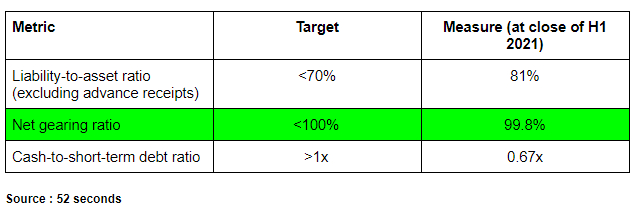
Direction-wise, this augurs well for the firm as it makes an earnest attempt to meet the ‘Three Red Lines’ criteria that were laid out by the PRC for the real estate sector in August 2020:

The three red lines:

  • Liability-to-asset ratio (excluding advance receipts) of less than 70%
  • Net gearing ratio of less than 100%
  • Cash-to-short-term debt ratio of more than 1x
  • Largely due to that debt-maturity, Evergrande — in the red — on three indicators until last year flashed green on ‘Net Gearing Ratio’ at close of H1 2021. This is how the firm stacks up now on these indicators:

    Total Liabilities — exceeding $300 billion by close of June 30, 2021 — presents a monster-sized problem for the firm though. Trade Payables, in particular, where most of the commercial papers are accounted for, stack up to a whopping $103 billion (To put that figure in perspective: Evergrande’s much larger rival, Country Garden, reported an Accounts Payable of $60 billion; in sharp contrast to Evergrande’s $95 billion Account Payable at close of 2020).

    The market for Commercial Papers can freeze up quickly if there are any doubts over its liquidity. Considering the sheer size of Evergrande, state-intervention appears imminent.

    Readers may recall the origins of the Commercial Paper Funding Facility (CPFF). It was created by the Fed on October 7th, 2008 to ease the credit crunch faced by financial market participants in the market for commercial papers.

    Regulatory reprieves may not come through for the beleaguered real-estate giant.

    The regulators appear to have wielded a heavy axe on the real estate sector since early last year to control house prices and land-banks. But the intent was clear as early as October 2017 when President Xi famously said:

    The regulators appear to have wielded a heavy axe on the real estate sector since early last year to control house prices and land-banks. But the intent was clear as early as October 2017 when President Xi famously said:

    Houses are built to be lived in, are not for speculation

    Homes account for approximately 70% of an individual’s wealth and the Chinese penchant to own multiple homes clashes jarringly with President XI’s vision of ‘Common Prosperity’

    How will China deal with a $300 billion moral hazard problem?

    The ‘moral hazard problem’ is the idea that certain firms know they are too big to fail. These firms then follow a path of recklessness with a singular focus on profits — often by leveraging aggressively — knowing that governments will bail them out if they fail.

    Were Corporates always too big to fail?

    Not really.

    The Great Depression was a full scale capitulation of the US economy. It lasted for 10 miserable years! Unemployment sky-rocketed and stayed at a sticky 25% for years (Remember: those were the days of sole breadwinners and 25% unemployment therefore meant that one out of four households had no income). More than 300,000 businesses downed their shutters. Bank runs swept the US and resulted in a wave of bank failures. One reason why a recession tipped into a severe depression then was the reluctance of the powers-that-be-then to intervene directly into the ailing economy. It was alright for ailing businesses — big or small — to fail. Expansionary policies were a taboo then. Bailouts did not exist in a Central Bank’s lexicon.

    That was 1939.

    We now move the plot-line a few decades ahead to 2008.

    Ben Bernanke’s Fed had a crisis of monstrous proportions on hand. The US economy was ailing and it was clear what had caused it. And yet, Ben Bernanke’s Fed chose to revive most big businesses that were on the brink of death.

    The Fed’s actions in 2008 were neither right nor wrong. They need to be viewed in context of what happened during the Great Depression.

    I have read multiple reports doing the rounds that this is China’s Lehman Moment. There are other reports that state this is China’s LTCM Moment.

    We will need to see this for it truly is: This is China’s Evergrande Moment.

    And China may choose to deal with it in an entirely different manner: perhaps by directing the People’s Bank of China to buy real estate units directly from Evergrande 🙂

    It’s interesting days ahead as we wait and watch: to see how China addresses it’s very own $300 billion-sized moral hazard problem.

    By

    Avinash Menon, CFA

    Founder and CEO,

    52 Seconds Capital Limited
    Other New Articles