Silicon Valley has always had one default setting: leave the upside uncapped.

And it works.

It is a large part of why we have more trillion-dollar market caps today than at any point in market history.

So when a company that took its annualised revenue from $14B in Feb to over $47B by May appears to have a handbrake bolted onto what looks like a pathway into orbit, it is worth a think.

Anthropic is a Public Benefit Corporation.

On its own, that is not the story.

Around 20 PBCs already trade publicly. Laureate listed in 2017. Lemonade and Vital Farms in 2020. Coursera, United Therapeutics, Warby Parker and Allbirds all followed. Veeva became the first listed company to convert into a PBC in 2021.

This road [PBC] is well-travelled. Directors must balance shareholder returns against a public benefit written into the charter and report on it.

What differs is what gets written into that charter.

Allbirds committed to environmental conservation. Warby Parker, to vision and eye health. That’s auditable – you can count the glasses.

Anthropic committed to responsibly developing and maintaining advanced AI for the long-term benefit of humanity.

There is no metric for that. Nothing to count. Which means the charter alone binds nobody.

So Anthropic added something no listed PBC has ever had.

Class T shares.

At first glance the idea rhymes with the mission-locked models across the Atlantic. Rolex, owned entirely by the Hans Wilsdorf Foundation. Novo Nordisk, controlled by the Novo Nordisk (NVO) Foundation.

Until you look closely …

The NVO Foundation holds roughly 28% of the share capital and about 77% of the votes. It holds control. It also holds economic rights – real dividend streams that fund the research the foundation exists to fund.

Control and financial sustenance live under the same roof.

Rolex is the same idea taken further. One trust, 100% ownership, no external shareholders to answer to at all.

Now Anthropic.

Class T carries no economic rights. No dividends. No liquidation preference.

What it carries instead is the right to elect a majority of the board.

Trustees who take nothing out of the company decide who runs it.

That’s the handbrake I was referring to earlier.

Every mission-locked structure pairs governance power with an economic stake. Anthropic has severed the two entirely. Nearly 20 PBCs have listed. None of them arrived with this.

And that sets up a nice predicament.

Its incoming shareholders will want precisely what Silicon Valley shareholders have always wanted – that path into orbit!

The T shares could prove to be annoying.

The 5 trustees have no incentives riding on it.

That is the design.

Upton Sinclair’s observation still holds: it’s difficult to get a man to understand something, when his salary depends on his not understanding it

Remains to be seen if the incredible T-shares are much more than mere tokenism.
By

Avinash Menon, CFA

Founder and CEO,

52 Seconds Capital Limited

Other New Articles

Consider the irony.

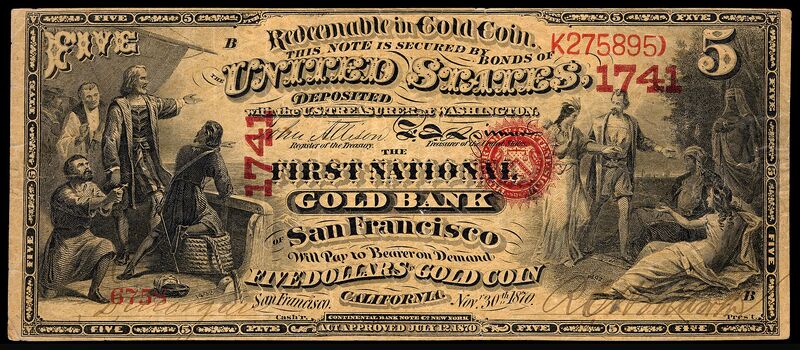
In 1933, the US dollar was still convertible to gold. And yet, that very year, Americans were prohibited from owning gold.

Executive Order 6102 forced citizens to hand in their gold.

Their currency was gold-backed, yes. But the citizen holding that gold-backed currency was not allowed to hold gold. That prohibition lasted 41 years – private ownership was only fully restored in 1974.

Cut to today.

There is a physical note called the Goldback. It is NOT federal legal tender, but it has actual fractional gold embedded into it. No questions about convertibility to gold since the note itself is the bullion asset.

Read that again.

The very thing the citizen was once barred from holding is now the promise printed into a private note.

Where was it launched?

Utah. In 2019. A state – among 11 states – that still recognises gold, silver, and sometimes platinum as a voluntary medium of exchange.

Since then, it has spread beyond its place of origin

The Goldback has since found acceptance across other red states – Nevada, New Hampshire, Wyoming, South Dakota, and more recently Florida, Oklahoma and Arizona.

Now, let me be clear about what this is not.

This is not a call to say Goldback will topple the dollar. It won’t. And this is certainly not a nudge to pile into it.

This is merely an observation.

Against a backdrop of peak debt and nagging questions around the purchasing power of fiat, the evolution of money is throwing up little experiments at the fringes.

Most will amount to nothing.

But ‘most’ is not ‘all’

And that sliver – that trend you were too quick to dismiss – is often where the next chapter of monetary history quietly begins.

Keep an eye on the fringes.

It’s where you must train yourself to look first.

By

Avinash Menon, CFA

Founder and CEO,

52 Seconds Capital Limited

Other New Articles

Working directly on client portfolios means you spend a lot of time not just on asset-allocation, security selection, time-horizons, return expectations, time horizon, and concentration checks; but also to observe the trends around the market structure itself.

In general, the market structure has evolved beautifully across time. We are at a sweet spot in time when spreads are razor-thin, liquidity is abundant, and execution venues are increasingly kept open for much longer.

And yet, every now and then, you come across a market where something doesn’t appear right under the hood.

Like something is freakishly off.

There appears to be something Squid Games-like about the Kospi now.

Like most markets, the KOSPI rules are uncompromising: an 8% drop triggers an automatic Level 1 circuit breaker, freezing all trading for 20 minutes to force a cooling-off period.

And these circuits have been triggered in the past.

Nothing out of the ordinary there.

But consider this.

In the entire history of the KOSPI, these halts have only been triggered 12 times.

Remarkably, 6 of those 12 market-wide halts have occurred this year.

Some of the reasons for this are well documented.

The fuel powering this frenetic trading is an active, domestic retail trading base that routinely drives volumes. Outstanding local margin debt recently exploded to a record-shattering 38 trillion won (~$24.8 Billion), with massive chunks of that focused on SK Hynix and Samsung.

What is less documented are the causes.

1. The Gamma Squeeze

When retail traders hoard out-of-the-money (OTM) calls on Samsung or SK Hynix, institutional market makers sell them the contracts. To hedge their risk, market makers must immediately buy the underlying shares. As this buying pushes the price up, Gamma accelerates their risk, forcing them to buy even more shares.

And that’s the wicked gamma squeeze playing out in all its horror.

2. The 20-50x Leveraged Perpetual Contracts (LPC)

There are other causes, more gory in nature:

Because local regulators enforce strict safety caps on-exchange to protect investors, an aggressive, stateless grey market has stepped in to feed the hunger for maximum risk. Major offshore crypto platforms have bypassed traditional capital controls entirely by launching synthetic futures contracts on Korea-linked equities.

Traders are potentially using stablecoins to buy into 20x-50x LPCs built on top of U.S.-listed 3x leveraged KOSPI ETFs.

The result?

A staggering 120-150x structural leverage on the underlying index.

A minor sub-1% daily swing in the KOSPI is all that it would take to completely wipe out a trader’s principal.

By

Avinash Menon, CFA

Founder and CEO,

52 Seconds Capital Limited

Other New Articles