Evergrande Group, the Chinese real-estate behemoth, is on shaky turf.
Scour the internet and you will come across hundreds of headlines that sound like obituaries of China’s second largest real estate developer. The noise levels around Evergrande’s inability to service its debt have ratcheted up since September 2020 after a leaked letter showed the group had requested for government support, signalling it faced a cash crunch. The firm’s inability to pay a commercial paper on time in June 2021 further added to suspicions that there was more to this developer’s solvency woes than what meets the eye.
The commercial paper story angle needs some explanation here.
What is a Commercial Paper?
Commercial paper, used commonly among financial market participants, is an unsecured, promissory, IOU kind of note with a fixed maturity rarely exceeding a year (Commercial Papers usually have a fixed-maturity of 270 days). These IOU’s are usually issued by ‘Blue-Chip’ companies — firms having relatively superior credit fundamentals — and hence can be bought and sold by its buyers and sellers who are rest-assured that they can be redeemed for cash.
A Commercial Paper is a low-cost alternative to a bank line of credit and makes it easier for a firm to fund its operating expenses (Think: financing Inventories, for example). While a Commercial Paper is cheaper than a line of credit and may be used instead of a bank line of credit, it still has some dependency on a bank. When a firm issues Commercial Papers it brings down the existing credit limit that the firm may have had with the bank. So yes, while the IOUs may be unsecured (not asset-backed), they are backed up by banks.
Missed or delayed payments on Commercial Payments are a major red flag.
This also explains the July 2021 news-story of a Chinese court freezing a $20 million — yes, read that again, it’s only $20 million — bank deposit held by the firm on the request of Guangfa Bank. Interestingly, the Chinese court ruled in favor of the lender despite the Rmb 132 million loan due only in March 2022. Evergrande responded to the court ruling by saying it would sue the lender.
Evergrande’s technically-correct grievance aside, that’s exactly how cross-defaults work: It’s never about the size of the amount due but about the inability of a firm to make a payment on time to any of the participants within its ecosystem.
Debt is a problem (but possibly a solvable one) but Payables is a monster-sized problem (and — without state-intervention — appears unsolvable)
The Evergrande Group, by the close of H1 2021, had a debt of $88.5 billion. This is significantly down from the $110 billion figure it reported at the close of 2020. This is a mild positive since this is the interest-bearing debt and, more importantly, Evergrande does not have any public bond maturities remaining in 2021 (The firm successfully paid $1.05 billion to the holders of its secured 8.9% 2021 bond which matured on 24th May).
Three Red-lines: One down, Two to go!
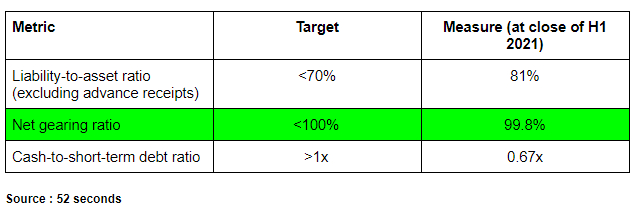
Direction-wise, this augurs well for the firm as it makes an earnest attempt to meet the ‘Three Red Lines’ criteria that were laid out by the PRC for the real estate sector in August 2020:
The three red lines:
Largely due to that debt-maturity, Evergrande — in the red — on three indicators until last year flashed green on ‘Net Gearing Ratio’ at close of H1 2021. This is how the firm stacks up now on these indicators:
Total Liabilities — exceeding $300 billion by close of June 30, 2021 — presents a monster-sized problem for the firm though. Trade Payables, in particular, where most of the commercial papers are accounted for, stack up to a whopping $103 billion (To put that figure in perspective: Evergrande’s much larger rival, Country Garden, reported an Accounts Payable of $60 billion; in sharp contrast to Evergrande’s $95 billion Account Payable at close of 2020).
The market for Commercial Papers can freeze up quickly if there are any doubts over its liquidity. Considering the sheer size of Evergrande, state-intervention appears imminent.
Readers may recall the origins of the Commercial Paper Funding Facility (CPFF). It was created by the Fed on October 7th, 2008 to ease the credit crunch faced by financial market participants in the market for commercial papers.
Regulatory reprieves may not come through for the beleaguered real-estate giant.
The regulators appear to have wielded a heavy axe on the real estate sector since early last year to control house prices and land-banks. But the intent was clear as early as October 2017 when President Xi famously said:
The regulators appear to have wielded a heavy axe on the real estate sector since early last year to control house prices and land-banks. But the intent was clear as early as October 2017 when President Xi famously said:
Houses are built to be lived in, are not for speculation
Homes account for approximately 70% of an individual’s wealth and the Chinese penchant to own multiple homes clashes jarringly with President XI’s vision of ‘Common Prosperity’
How will China deal with a $300 billion moral hazard problem?
The ‘moral hazard problem’ is the idea that certain firms know they are too big to fail. These firms then follow a path of recklessness with a singular focus on profits — often by leveraging aggressively — knowing that governments will bail them out if they fail.
Were Corporates always too big to fail?
Not really.
The Great Depression was a full scale capitulation of the US economy. It lasted for 10 miserable years! Unemployment sky-rocketed and stayed at a sticky 25% for years (Remember: those were the days of sole breadwinners and 25% unemployment therefore meant that one out of four households had no income). More than 300,000 businesses downed their shutters. Bank runs swept the US and resulted in a wave of bank failures. One reason why a recession tipped into a severe depression then was the reluctance of the powers-that-be-then to intervene directly into the ailing economy. It was alright for ailing businesses — big or small — to fail. Expansionary policies were a taboo then. Bailouts did not exist in a Central Bank’s lexicon.
That was 1939.
We now move the plot-line a few decades ahead to 2008.
Ben Bernanke’s Fed had a crisis of monstrous proportions on hand. The US economy was ailing and it was clear what had caused it. And yet, Ben Bernanke’s Fed chose to revive most big businesses that were on the brink of death.
The Fed’s actions in 2008 were neither right nor wrong. They need to be viewed in context of what happened during the Great Depression.
I have read multiple reports doing the rounds that this is China’s Lehman Moment. There are other reports that state this is China’s LTCM Moment.
We will need to see this for it truly is: This is China’s Evergrande Moment.
And China may choose to deal with it in an entirely different manner: perhaps by directing the People’s Bank of China to buy real estate units directly from Evergrande 🙂
It’s interesting days ahead as we wait and watch: to see how China addresses it’s very own $300 billion-sized moral hazard problem.
By
Avinash Menon, CFA
Founder and CEO,
52 Seconds Capital Limited